Exam guide · Cambridge
Cambridge C1 Advanced examparts, timing and what each paper is like
C1 Advanced (formerly CAE) certifies an advanced level of English and is one of the certificates most valued by universities and employers. Here’s how it’s organised: the four papers, how long each part takes, the tasks you’ll face and how your score is calculated.
 By the Hugschool team · Updated October 2026 · 9 min read
In this guide
What is C1 Advanced?
C1 Advanced (formerly CAE, Certificate in Advanced English) is an official Cambridge English exam that certifies C1 level on the Common European Framework (CEFR): you can use English fluently and precisely in demanding academic and professional settings, such as studying at university or working in an international environment.
It’s accepted by thousands of universities, employers and governments worldwide, and the certificate never expires. The format is the same on paper and on computer. If you’re coming from B2 First, the structure will feel familiar, but the texts are longer and the tasks more demanding.
The 4 C1 Advanced papers at a glance
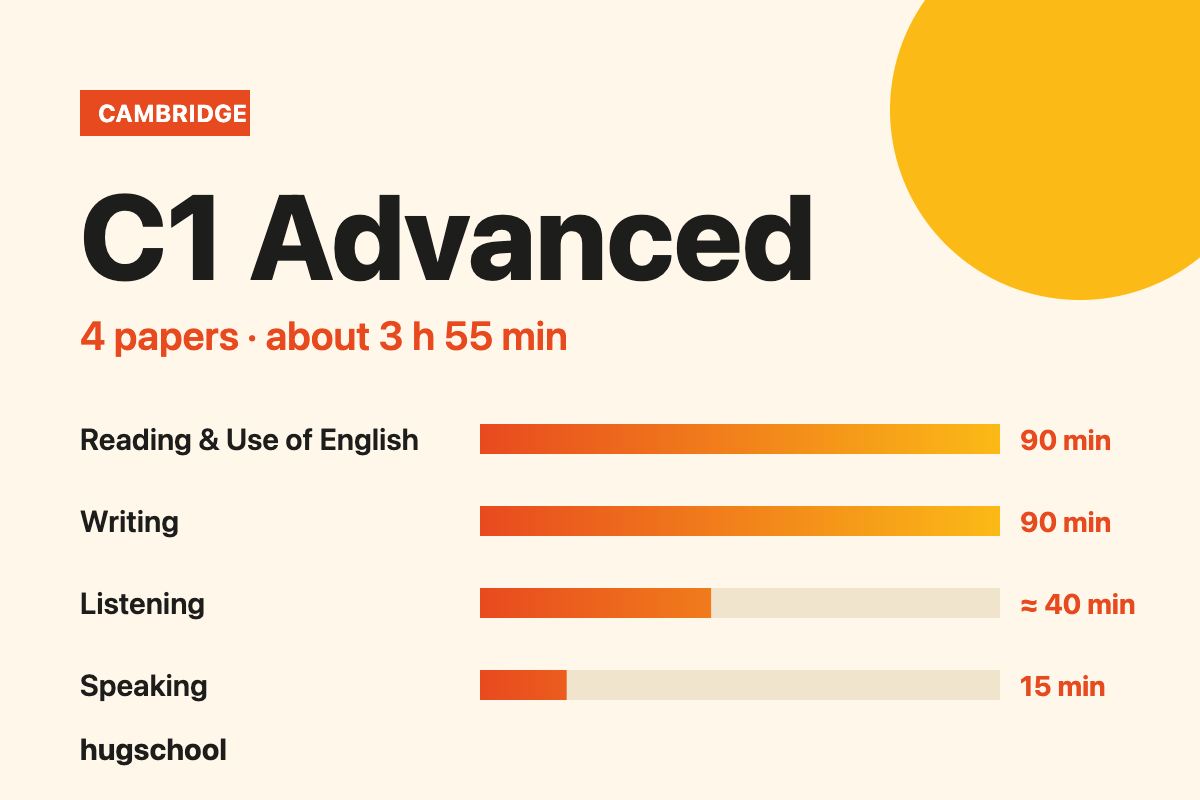
The exam has four papers and lasts about 3 hours 55 minutes in total. The written papers are taken on the same day; the Speaking test may be on the same day or on a nearby date.
| Paper | Time | Parts | Questions | Weight |
|---|---|---|---|---|
| Reading and Use of English | 1 h 30 min | 8 | 56 | 40% |
| Writing | 1 h 30 min | 2 | 2 texts | 20% |
| Listening | About 40 min | 4 | 30 | 20% |
| Speaking | 15 min (in pairs) | 4 | — | 20% |
Reading and Use of English (1 h 30 min)
This is the longest paper: 8 parts and 56 questions in 90 minutes. Parts 1–4 test grammar and vocabulary (Use of English) and Parts 5–8 test reading comprehension, with long texts from newspapers, magazines, books and websites.
- 1
Multiple-choice cloze 8 questions · 1 mark
Choose the right word (A–D) for each gap. It tests advanced vocabulary: collocations, phrasal verbs and fixed expressions.
- 2
Open cloze 8 questions · 1 mark
Write the missing word in each gap, with no options. It tests grammar and structure.
- 3
Word formation 8 questions · 1 mark
Change the given word (prefixes, suffixes, word class) to complete the text.
- 4
Key word transformations 6 questions · up to 2 marks
Rewrite a sentence using a key word, in 3–6 words, without changing its meaning. Partial marks are possible.
- 5
Multiple choice 6 questions · 2 marks
A long text with multiple-choice questions on detail, opinion, tone, purpose and implication.
- 6
Cross-text multiple matching 4 questions · 2 marks
Four short texts by different writers on the same topic. You compare their views: who agrees or disagrees with whom.
- 7
Gapped text 6 questions · 2 marks
Put paragraphs that have been removed from a long text back in the right place (there’s one extra).
- 8
Multiple matching 10 questions · 1 mark
Match statements to the text or section where they appear. You need to read quickly and locate information.
Writing (1 h 30 min)
You write two texts of 220–260 words each. You have 90 minutes, so aim for about 45 minutes per part, including a few minutes to plan and check.
- 1
Essay (compulsory) 220–260 words
Read some notes (for example, from a lecture or discussion) with three points. Develop two of them, explain which is more important and justify your view.
- 2
One task from a choice 220–260 words
Choose one of three options: letter or email, proposal, report or review.
You’re assessed on content, organisation, communicative achievement and language. At C1, examiners expect an appropriate register, varied linking and precise vocabulary: avoiding mistakes isn’t enough.
Listening (about 40 min)
There are 4 parts and 30 questions. You hear each recording twice, with a range of accents and situations such as interviews, talks, discussions and monologues.
- 1
Multiple choice 6 questions
Three short, unrelated conversations, each with two three-option questions.
- 2
Sentence completion 8 questions
Complete sentences with information from a monologue of about 3 minutes. Write the word exactly as you hear it.
- 3
Multiple choice 6 questions
An interview or conversation of about 4 minutes with six four-option questions.
- 4
Multiple matching 10 questions
Five people talk about a topic. You do two tasks at once: for each speaker, choose one option from each list of eight.
Speaking (15 minutes)
The Speaking test is taken in pairs (or in groups of three, lasting 21 minutes). There are two examiners: one runs the test and the other just listens and assesses.
- 1
Interview 2 minutes
General questions about you, your studies or work, your interests and your opinions.
- 2
Long turn 4 minutes
You get three photos and talk about two of them for 1 minute, answering two questions. Then you comment briefly on your partner’s photos.
- 3
Collaborative task 4 minutes
Discuss a question with your partner using several written prompts (2 minutes), then try to reach a joint decision (1 minute).
- 4
Discussion 5 minutes
More abstract questions linked to the Part 3 topic, where you give, qualify and justify your opinions.
You’re assessed on grammar and vocabulary, discourse management, pronunciation and interactive communication. At C1 it really counts to develop ideas, speculate and add nuance, not just answer.
How it’s scored and when results arrive
Each skill receives a score on the Cambridge English Scale, and the average gives your overall result. That score determines your grade and CEFR level:
| Score | Result | CEFR level |
|---|---|---|
| 200–210 | Grade A | C2 |
| 193–199 | Grade B | C1 |
| 180–192 | Grade C | C1 |
| 160–179 | Level B2 | B2 |
- Pass: from 180 points you get the C1 certificate.
- Exceptional performance: with 200 or more the certificate shows C2 level.
- If you don’t reach 180: with 160–179 you receive a B2-level certificate.
- Results: faster for the computer-based exam; on paper in about 4–6 weeks.
- Photo: since April 2026 your test-day photo appears on the Statement of Results and is compulsory to sit the exam.
Tips for exam day
- Do timed practice tests. C1 is long: building the stamina to concentrate for almost four hours is part of your preparation.
- Answer everything. Wrong answers don’t lose marks.
- In Writing, follow the format. A proposal, a report and a review are structured differently, and examiners notice.
- Build vocabulary in context. Collocations and phrasal verbs are key in Use of English.
- In Speaking, develop your answers and talk to your partner: interaction is marked too.
- Choose paper or computer depending on what you’re most comfortable with: the format is identical and digital results arrive sooner.
Prepare for C1 Advanced in Barcelona
How we prepare you at Hugschool
Hugschool is an official Cambridge centre in El Clot, and we’ve been preparing students for their exams for more than 10 years. We work in small groups with real timed mock exams and detailed feedback on Writing and Speaking, so you walk into the exam knowing exactly what to expect.
Take a look at our Cambridge exam preparation and our English courses. Not sure if you’re ready for C1? Try our level test.
C1 Advanced: frequently asked questions
How long is the C1 Advanced exam?
About 3 hours 55 minutes in total: Reading and Use of English (1 h 30 min), Writing (1 h 30 min), Listening (about 40 min) and Speaking (15 min in pairs).
How many parts does C1 Advanced have?
Four papers and 18 parts in total: 8 in Reading and Use of English, 2 in Writing, 4 in Listening and 4 in Speaking.
What score do I need to pass C1 Advanced?
180 on the Cambridge English Scale. From 180 to 199 you get C1 (grades C and B), and 200 or more gives you a C2-level certificate (grade A).
What if I don’t reach C1?
If you score between 160 and 179, you receive a certificate showing B2 level.
Does C1 Advanced expire?
No. The certificate has no expiry date, although some universities or employers may ask for a recent one.
What’s the difference between B2 First and C1 Advanced?
C1 Advanced is longer (about 25 minutes more), has one more part in Reading and Use of English, longer Writing tasks (220–260 words) and demands more precise vocabulary and register.