 hug
hugDELE vs SIELE: the differences and which one to take in 2026
Both certify your level of Spanish and both are backed by the Instituto Cervantes, but they are not used for exactly the same things. Here is how they differ, which one you need for Spanish citizenship, university or work, and which one suits your goal and your timeline.
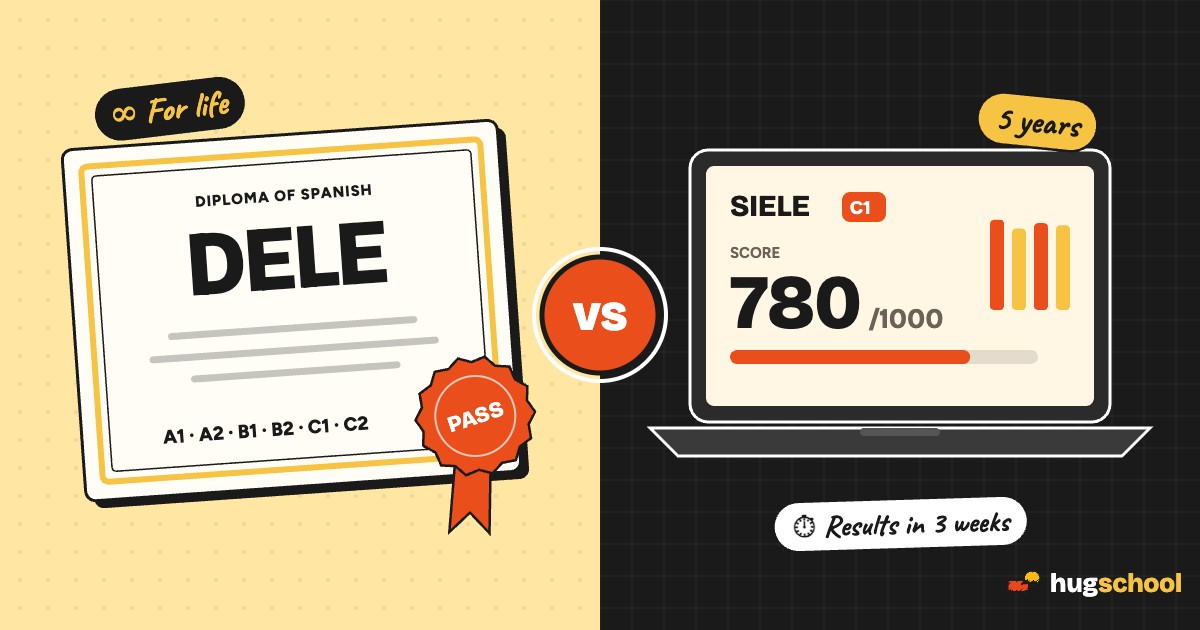
The difference in 30 seconds
- DELE: an official diploma that never expires. You sit one specific level (A1 to C2) and either pass or fail. Fixed exam dates several times a year.
- SIELE: a computer-based certificate valid for 5 years. One exam gives you a score from 0 to 1000 and a level from A1 to C1. Flexible dates and results within 3 weeks at most.
- For Spanish citizenship you need the DELE A2 or higher, not the SIELE.
DELE and SIELE side by side
| DELE | SIELE | |
|---|---|---|
| Issued by | Instituto Cervantes, on behalf of Spain’s Ministry of Education | Instituto Cervantes, UNAM (Mexico), University of Salamanca and University of Buenos Aires |
| Levels | One exam per level: A1, A2, B1, B2, C1 and C2 | A single exam that places you between A1 and C1 |
| Result | Pass or fail | Score from 0 to 1000 (250 per test); you can’t fail |
| Format | In person, on fixed exam dates | On computer at an exam centre, by appointment |
| Results | In about 3 months | Within 3 weeks at most |
| Validity | Indefinite | 5 years |
| Best for | Citizenship, a lifelong qualification, C2 level | University, work, tight deadlines, certifying only some skills |
What is the DELE?
The Diplomas of Spanish as a Foreign Language (DELE) are the official qualifications that certify your level of Spanish. They are awarded by the Instituto Cervantes on behalf of Spain’s Ministry of Education and are valid indefinitely: once you pass, the diploma is yours for life.
Each level is a separate exam. You choose the level you sit (A1, A2, B1, B2, C1 or C2) and the result is pass or fail. That is why choosing the right level matters: if you fall short, you get no diploma at all, even if your real level is very close.
There are also school versions (A1, A2/B1 and B2/C1) for students aged 11 to 17.
What is the SIELE?
The SIELE (International Service for the Evaluation of the Spanish Language) is a newer certificate, backed by the Instituto Cervantes, the National Autonomous University of Mexico, the University of Salamanca and the University of Buenos Aires. It assesses Spanish from across the Spanish-speaking world, with accents and varieties from different countries.
You take it on a computer at an exam centre, by appointment, and you can’t pass or fail: you get a score from 0 to 1000 and the CEFR level that matches it, from A1 to C1. The certificate is valid for 5 years.
You also don’t have to take the whole thing. You can choose the SIELE Global (all four tests) or a partial option:
- S1: Reading + Listening
- S2: Reading + Writing
- S3: Listening + Speaking
- S4: Speaking only
- S5: Writing + Speaking
DELE or SIELE? Which one you need
For Spanish citizenship
You need the DELE A2 or higher, plus the CCSE test on the Spanish constitution and society. The SIELE is not accepted for this. Nationals of Spanish-speaking countries are exempt from the language test.
For a university degree or master’s
Many universities accept both. What usually decides it is the level they ask for and the deadline. If enrolment closes in a few weeks, the SIELE is almost always the realistic option, because it doesn’t depend on fixed exam dates and results arrive within 3 weeks. Always check which certificates your university accepts before you register.
For work or your CV
If you want a qualification that never expires, take the DELE. If you need to prove your level soon, or you’re only asked for certain skills (speaking, for example), the SIELE and its partial options are more flexible.
If you’re aiming for the top level
Only the DELE goes up to C2. The SIELE certifies up to C1.
Not sure of your level? A level test before you register stops you sitting the wrong DELE level, or paying for a SIELE before you’re ready.
What each exam is like
DELE
Every level tests the four skills: reading, listening, writing and speaking. The speaking test is face to face with examiners, usually on the same day as the written papers or close to it.
To get the diploma you need at least 60 points out of 100, and also at least 30 points in each of the two groups of tests. In other words, you can’t fully make up for one very weak skill with the others.
SIELE Global
| Test | Approx. length | Score |
|---|---|---|
| Reading | 60 min | 0–250 |
| Listening | 55 min | 0–250 |
| Writing | 50 min | 0–250 |
| Speaking | 15 min | 0–250 |
It takes about 3 hours in total. The speaking test is also done on the computer: you listen to the tasks and record your answers, which an examiner then marks.
Dates, results and cost
DELE: there are several exam sessions a year, with fixed dates and registration deadlines. The last 2026 sessions are on 16–17 October and 13–14 November, and registration for both has closed. The fee depends on the level and is set each year by the Instituto Cervantes: in Spain it ranges from about €112 for A1 to over €200 for the higher levels. Results take about 3 months.
SIELE: there are no fixed sessions. You book a day and time at an exam centre, often just a few days ahead, and get your result within 3 weeks. The fee depends on the option you choose; the SIELE Global is the most complete.
If you need a Spanish certificate before the end of the year, the SIELE is currently the fastest route.
How to prepare for the DELE or the SIELE
- Confirm which exam and level you need. Ask the university, employer or authority to put the requirement in writing.
- Take a level test. Knowing where you are tells you how many weeks you need and, for the DELE, which level to sit.
- Practise with the real format. The DELE rewards accuracy in very specific tasks; the SIELE means managing your time on screen and recording your speaking without a live partner.
- Get feedback on your writing and speaking. That’s where most points are lost, and where a teacher makes the biggest difference.
Prepare for the DELE or SIELE with Hugschool in El Clot
We are an official SIELE exam centre, so you can prepare and sit the exam in the same place, next to Clot metro. We also prepare students for every DELE level, in small groups with native teachers.
- In-person intensive SIELE preparation: 20 lessons a week, from €180 per week.
- 4, 8 or 12-week packages in our virtual classroom if you’d rather prepare online.
- Timed mock exams with detailed feedback on writing and speaking.
DELE and SIELE: frequently asked questions
Is the SIELE accepted for Spanish citizenship?
No. Citizenship requires the DELE A2 or higher, together with the CCSE test.
Does the DELE expire?
No. The DELE is valid indefinitely. The SIELE, by contrast, is valid for 5 years.
Can you fail the SIELE?
No. Everyone gets a score from 0 to 1000 and the matching level, from A1 to C1. The institution asking for it decides the minimum level you need.
When will I get my results?
SIELE results arrive within 3 weeks. DELE results take about 3 months after the exam.
Which is harder, the DELE or the SIELE?
The level required is comparable, but the DELE is tougher in one way: if you don’t reach the level you sit, you get nothing. With the SIELE you always come away with a certificate showing your real level.
Can I take the SIELE at Hugschool?
Yes. Hugschool is an official SIELE exam centre in El Clot, Barcelona. Get in touch and we’ll help you choose the right option and date.